Google Lake Ontario
The results are not what they used to be


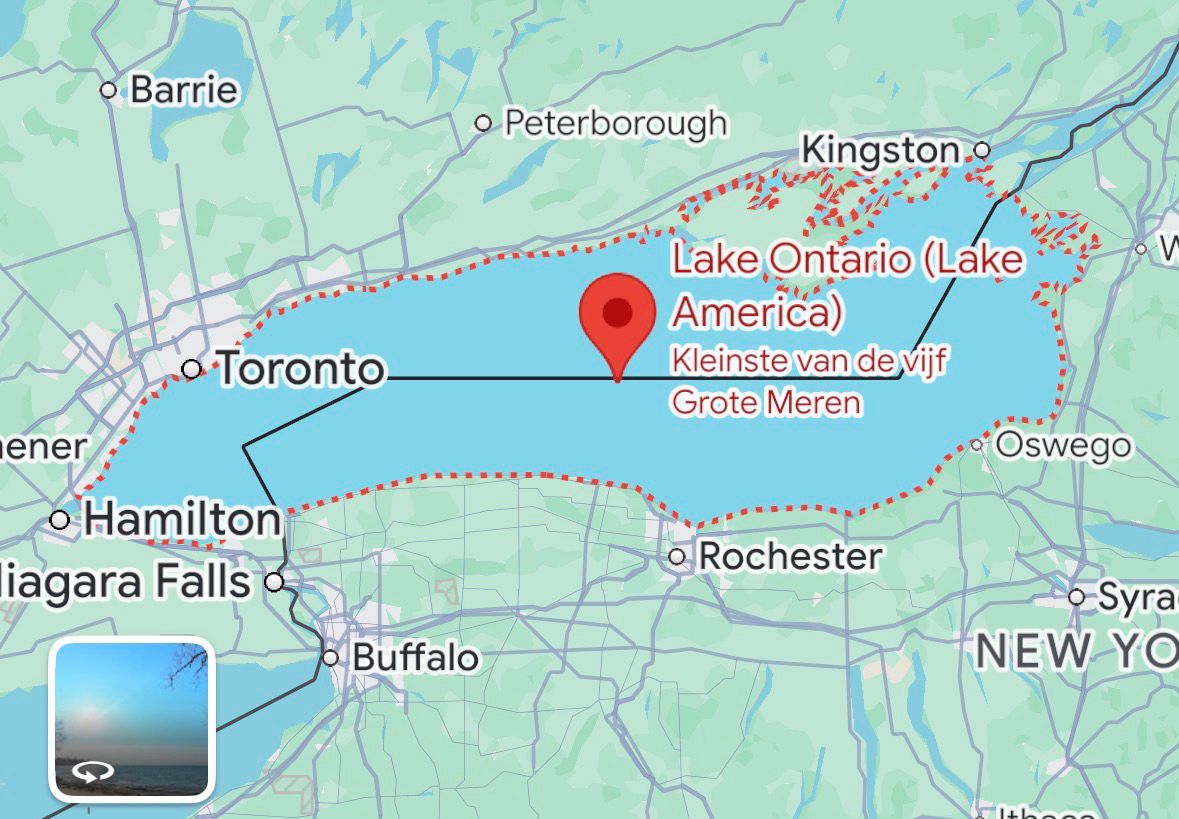
I've been thinking a bit about the Lake America thing from a GIS perspective. Like, should I be upset with Google, or just Trump?
tl;dr: Yes, but no, but yes.
Yes, google sucks
Being mad at Google is a reasonable knee-jerk reaction, given how they gave Trump $1M for no good reason. And, of course, all manner of other things big and small they did over the past couple of decades that go against their abandoned, "Don't be evil" motto.
That said, most people who follow GIS know about the concept of localization, so this isn't that unusual on the surface.
No, there's a reasonable explanation
Localization
Pretty much all mapping platforms localize based on government laws & preferences. For instance, displaying the body of water between Japan and mainland Asia as the "Sea of Japan" to people located in Japan, and the "East Sea" to people located in the Korean peninsula.
Even Open Street Map (OSM) has Denali & the Gulf of Mexico tagged incorrectly (Trump is incorrect), for the US-localized entity tags, but correctly for the standard English tags.
Tag ID | Tag Value |
|---|---|
name:en | Denali |
official_name:en-US | Mount McKinley |
name:en | Gulf of Mexico |
official_name:en-US | Gulf of America |
But currently, OSM & google differ on Lake Ontario. That will change. They will soon be in agreement.
Sources
OSM is going by the U.S. Board on Geographic Names (BGN), while google uses the Geographic Names Information System (GNIS). These are both related, and both are related to the U.S. Geological Survey (USGS), so there is maybe some hair-splitting going on.
Given my bias, you'd think I'd prefer BGN (what OSM uses), but GNIS actually makes more sense to use from a technical perspective.
GNIS is more like a database, while BGN is a bureaucratic entity. BGN will rubber stamp Trump's asinine requests, just like they have before. GNIS doesn't wait for BGN to meet. It gets updated right away after an executive order.
Economics of different maps
OSM is a wiki. They can afford the manpower to go by the bureaucracy instead of just getting official data programmatically, at least for high-visibility items.
That allows them to be more deliberate with their changes. But, they'll capitulate. They have a history of capitulation because localization is such a common solution, and I guess because they don't have the manpower to deal with endless MAGA trolls. They've settled on a standard practice that is very similar to Google's.
BGN will agree with Trump. GNIS and BGN will align. OSM will agree with google.
What about MapQuest? They're doing a publicity stunt. It's working. Good on them making the right choice when their place in the market supports the right choice. Yes, that's cynical. I still remember when Google was small and not evil.
Google got big enough to engage in regulatory capture and rent seeking, which makes their market incentives support different kinds of behaviors than MapQuest.
Ok, so Google's behavior is pretty normal, so they're off the hook and all of my ire should be directed at Trump, right? Not quite.
Yes, google is actually being weird
Odd presentation to 3rd parties

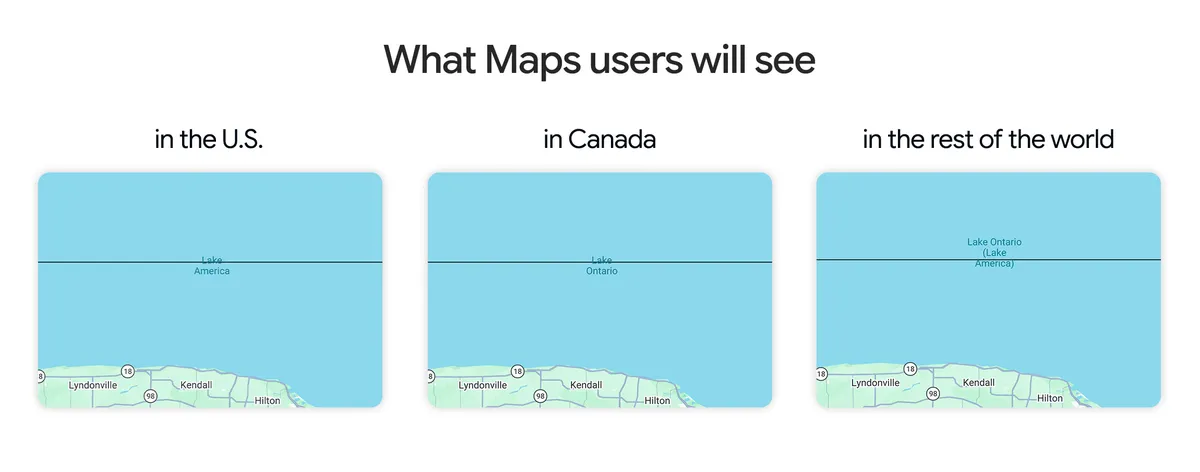
While it's pretty standard localization practice to show "Lake America" to people who are in the US, the other part of the standard practice would be to simply show "Lake Ontario" to people outside of the US. That's not what they're doing.
They're showing both names to people outside of the US and Canada, "Lake Ontario (Lake America)". That's weird.
Most maps show territorial disputes the way their government wants it shown. They don't broadcast these disputes across the globe.
Incoherent policy
They're citing their "longstanding policy for bodies of water with names that vary from country to country," which is sane-washing an incoherent policy.
Why do this for just bodies of water? Why not show Taiwan to Americans as "Taiwan (Republic of China)", so I know about their naming dispute on the other side of the earth? Because there are multiple territory claims on the body of water? That really only happens with bodies of water?
Seems like the sort of narrow carve out judges like to do to get a desired outcome without impacting the law much.
Regulatory amnesia
So, I did a quick search and found a Google blog post from 2008 that directly contradicts this "longstanding" policy.
They used to have a policy of displaying the "primary, common, local" names. It's worth reading their explanation of those terms (emphasis added):
When our policy says that we display the "primary, common, local" names for a body of water, each of those three adjectives has an important and distinct meaning. By saying "primary", we aim to include names of dominant use, rather than having to add every conceivable local nickname or variation. By saying "common", we mean to include names which are in widespread daily use, rather than giving immediate recognition to any arbitrary governmental re-naming. In other words, if a ruler announced that henceforth the Pacific Ocean would be named after her mother, we would not add that placemark unless and until the name came into common usage. Finally, by saying "local", we aim to reflect the primary and common names used by countries that actually border the body of water, as they are the countries recognized under international law as having a special sovereign stake in it.
Note the underlined portion. Seems like their policy makers were forward-thinking enough to account for a capricious leader acting foolish. But, you know, a hypothetical one, somewhere far away, in a country where Google isn't engaging in regulatory capture. Or maybe a small one that has no leverage.
Conclusion
Google is going above and beyond.
Stop using Google to whatever degree you can. I know this is difficult for many and maybe impossible, at least in the near term, but it's something to work on. I'm not rid of them yet, but I'm slowly replacing their services with alternatives.
If you live in a country that isn't the US or Canada, see if you can get your government to come down on a side.